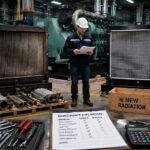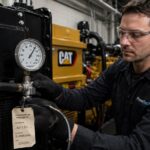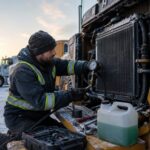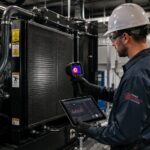
A generator hums steadily under load. A haul truck climbs, pushing against its limits. Inside the system, temperatures begin to rise almost imperceptibly at first. Performance slowly declines, components work harder than they should, and efficiency starts to slip. Eventually, failure becomes unavoidable.
This pattern is common in heavy equipment. It doesn’t happen suddenly or dramatically, but over time, it leads to costly downtime and repairs.
At the center of this process is a component that is often overlooked: the radiator.
Industrial cooling systems aren’t just about keeping machines “cool.” They manage pressure, preserve materials, and quietly dictate how long equipment survives in demanding environments. And when radiator performance drops even slightly, the entire system starts to wobble.
At a basic level, industrial cooling systems manage heat generated by machinery, engines, and production processes, but this simple definition misses their complexity.
These systems move heat away from critical components using fluids, airflow, and engineered surfaces. In practice, they must handle fluctuating loads, harsh environments, and long operating cycles without failure.
A short, direct way to think about it:
Industrial cooling systems are engineered networks designed to regulate temperature and prevent heat-related damage in heavy-duty equipment.
They show up everywhere manufacturing plants, mining operations, transport fleets, and power generation facilities. Anywhere heat builds faster than it can dissipate, cooling becomes mission-critical.
Within these systems, the radiator acts as the final stage of heat dissipation.
The industrial radiator function is straightforward in theory: to transfer heat from the coolant into the surrounding air. In reality, it’s a balancing act between airflow, fluid dynamics, and material conductivity.
When working properly, a radiator:
However, one commonly overlooked fact is that radiators do not fail all at once.
Instead, they degrade gradually over time.
Fins become clogged with debris, internal passages begin to narrow, and small leaks slowly reduce system pressure. None of these issues appears catastrophic at first. Yet over time, heat transfer efficiency drops just enough to create stress elsewhere in the system.
That is where problems begin to multiply.
Most industrial cooling problems don’t come from a single point of failure. They build gradually, often unnoticed until performance dips.
A few patterns tend to repeat across industries:
This is where the situation becomes more complex. Operators may notice rising temperatures, but the root cause isn’t always obvious. It might look like an engine issue or a pump failure.
In many cases, the issue can be traced back to reduced radiator performance.
Not all radiators are designed to handle the same operational demands. Not all radiators are designed to handle the same demands, which becomes evident under extreme loads or harsh environments.
High performance radiators are designed to handle those conditions with greater consistency. They typically offer:
The difference may not be immediately noticeable. However, over time, it results in fewer overheating incidents and more stable performance.
A widely cited finding from the U.S. Department of Energy notes that improving system efficiency in industrial operations can reduce energy use by up to 10–20% in some cases when thermal management is optimized.
That kind of improvement doesn’t come from a single upgrade, but radiator performance plays a measurable role.
Standard replacements work well in predictable environments, but industrial operations rarely remain predictable.
That’s where custom radiator manufacturing becomes relevant.
Instead of forcing equipment to adapt to a generic component, custom solutions adjust to the system itself:
Custom solutions are not always the most obvious choice. Custom fabrication can require more planning upfront. However, in systems where downtime is costly or access is limited, it often proves more practical in the long run.
There is also a subtle advantage: fewer compromises in performance and design.
When cooling issues start to surface, the challenge is knowing what to check first. Instead of guessing, a simple evaluation framework can help.
A 5-point cooling system check:
The process is not complicated. However, it ensures attention is given to areas that are often overlooked.
During inspections, operators often realize that the problem is not obvious but rather subtle. The table below highlights how symptoms connect to underlying causes.
| Symptom Observed | Likely Cause | What To Check First | Common Misstep |
| Gradual overheating | Reduced heat transfer | Radiator fin blockage | Replacing the thermostat too quickly |
| Sudden temperature spikes | Coolant flow restriction | Internal core buildup | Ignoring the radiator condition |
| The engine is running hotter under load | Undersized cooling capacity | Radiator size vs load | Blaming ambient conditions |
| Frequent coolant loss | Minor leaks or pressure issues | Radiator seams and joints | Overfilling coolant repeatedly |
| Uneven temperature distribution | Airflow imbalance | Fan and shroud alignment | Assuming fan failure only |
Patterns like these tend to repeat across different types of industrial radiator applications.
There’s a common assumption that cooling systems either work or they don’t.
In reality, cooling system performance is more complex.
Cooling performance often declines gradually. By the time overheating becomes obvious, the system may have been underperforming for weeks or months.
Another misconception: replacing parts automatically fixes the issue.
In some cases, swapping a radiator without addressing airflow, coolant quality, or system design leads to the same problem repeating. Just later.
For operations dealing with recurring overheating or system inefficiencies, working with specialists in industrial radiator services Canada can shift the approach from reactive fixes to long-term performance planning.
King Radiator HD Inc supports industries that rely on consistent, heavy-duty cooling performance by offering repair, custom fabrication, and system-level solutions tailored to real operating conditions.
Cooling demands vary widely, but certain sectors rely heavily on stable performance:
Each comes with its own challenges, which is why industrial cooling solutions Canada often require more than off-the-shelf components.
When systems begin to show strain, addressing radiator performance early can prevent larger failures later. It may not always be the first place teams look—but it’s often where the solution begins.
Heat doesn’t announce itself loudly in industrial systems. It builds quietly, affects performance gradually, and only becomes obvious when damage is already underway.
This is why radiator performance is more critical than it may initially appear.
In industrial cooling systems, small inefficiencies can ripple outward affecting fuel use, uptime, and equipment lifespan. Paying attention early tends to cost less, disrupt less, and solve more.
A good system balances heat load, airflow, and coolant efficiency while maintaining stable temperatures under varying operating conditions.
Regular cleaning, coolant checks, and airflow inspections tend to prevent gradual efficiency loss.
Look for small temperature increases, reduced efficiency, or uneven heat distribution during normal operation.
When overheating becomes consistent or system performance drops without a clear cause, professional evaluation is usually needed.
They offer radiator repair, custom manufacturing, and full industrial cooling system support for heavy-duty applications.