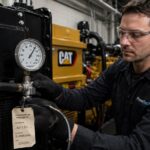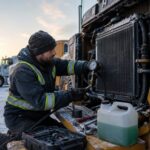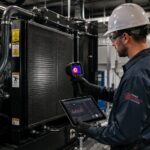

Radiator pressure testing pressurizes a standby generator’s cooling system typically to somewhere in the 10–16 psi range, depending on the manufacturer’s rating and holds it there while a technician checks seams, hoses, the core, and fittings for leaks that a visual inspection alone won’t catch. Done once a year, and always before a heavy-load season, it’s the single best way to catch a weak cooling system before an outage forces it to prove itself.
When the lights go out, everything stops. HVAC shuts down. Production lines freeze. Elevators stall between floors. In that moment, a standby generator is expected to start instantly even after sitting idle for months.
It doesn’t always work out that way.
Most generator failures during an actual outage aren’t engine failures at all. The cooling system wears down quietly in the background while the generator sits unused. Without regular Cooling System Maintenance, pinhole leaks can form, radiator caps can weaken, and corrosion can spread inside the core, invisible from the outside. None of it shows up until the system finally reaches full operating temperature which is exactly the moment you can least afford a surprise.
That’s the case for annual radiator pressure testing. It isn’t a box-checking maintenance ritual; it’s one of the more reliable ways to protect the whole standby system’s reliability.
Standby generators are actually more vulnerable to this kind of failure than equipment that runs constantly. Long idle stretches let coolant sit and degrade. Hoses harden. Small leaks develop without anyone noticing, because nothing’s under pressure to expose them. Then a heat wave or an ice storm hits, the generator has to run under real load, pressure climbs and whatever was quietly failing finally gives out.
At its core, the test answers one question: can this cooling system hold pressure without leaking?
A technician pressurizes the radiator and cooling system to the level specified by the generator manufacturer commonly in the 10–16 psi range, though it varies by unit with the engine off. From there, it’s a matter of watching the gauge and checking every seam, tank, hose, fitting, and weld for pressure loss.
A healthy system holds steady. If the needle drops, something is escaping somewhere, even if there’s no puddle on the floor to prove it.
That last part is what makes the test worth doing. Small leaks often flash off the moment coolant touches a hot engine surface, leaving no visible trace. Some only appear once the system reaches full operating pressure. Others are buried inside the radiator core, where corrosion has been working from the inside out for months before anyone would think to look.
There’s a common assumption that equipment sitting unused stays in good shape. For standby generators, that’s only half true idle time creates its own kind of wear.
A radiator can look completely fine and still be operating at reduced efficiency. Visual inspections won’t catch internal corrosion or a partially restricted flow path that’s why a real preventative maintenance plan pairs pressure testing with periodic internal cleaning, not one or the other.
It’s a familiar pattern in this line of work: equipment that “ran fine last year” suddenly overheats the first time it’s asked to run long and hard. The warning signs were almost always there. They just weren’t visible yet.
A weekly no-load exercise cycle tells you very little about how the radiator will actually perform. Heat changes everything.
During a real outage, standby systems often run continuously for hours, sometimes days, carrying elevators, servers, medical equipment, refrigeration, or manufacturing lines. Engine temperatures climb. Coolant expands. Pressure builds throughout the radiator assembly in a way a light exercise cycle never replicates. Weak points that look fine on a routine startup test can fail once real load is on the system.
This is exactly why load bank testing exists alongside pressure testing, and why the two get paired so often in facility maintenance programs.
Load bank testing: Running the generator against an artificial electrical load often up to 100% of its nameplate rating to simulate the demand of a real outage. Routine no-load exercise cycles don’t stress the cooling system enough to expose problems; load bank testing does.
Re-coring: Replacing the radiator’s internal core (the finned tube assembly that transfers heat) while reusing the original tanks and housing typically far less costly than full radiator replacement.
Corrosion inhibitors: Additives in the coolant that protect metal surfaces inside the cooling system from rust and electrolytic corrosion. They deplete over time, even in a generator that’s rarely run.
For facilities operating under NFPA 110 the standard covering emergency and standby power systems periodic full-load testing is already part of the compliance picture, and cooling-system issues are consistently among the problems that testing regime is designed to surface. Radiator pressure testing complements that process by catching leaks and weak points before they show up as a failed load test or, worse, a failed real outage.
| Cooling System Issue | What Usually Causes It | Early Warning Sign | What Happens If Ignored |
| Small coolant leak | Corrosion or vibration stress | Sweet coolant smell or residue | Overheating during extended runtime |
| Weak radiator cap | Pressure seal deterioration | Inconsistent coolant levels | Coolant boiling at lower temperatures |
| Blocked radiator fins | Dust, debris, oily buildup | Rising operating temperatures | Reduced heat dissipation |
| Internal core restriction | Scale or coolant contamination | Uneven temperature readings | Poor coolant circulation |
| Hose deterioration | Aging rubber and heat cycling | Soft spots or cracking | Sudden hose rupture |
Once a year, at minimum and always ahead of a facility’s highest-risk season, whether that’s summer heat or winter storms. Facilities running under formal load-testing programs typically fold radiator pressure testing into that same annual cycle, since both are checking for the same underlying weaknesses. Generators that operate in dusty, high-heat, or industrial environments often benefit from checking more frequently than that baseline.
Cooling system failures rarely happen at a convenient time. They show up during storms, overnight, or right in the middle of peak demand which is exactly what makes them expensive.
A leaking radiator caught during scheduled maintenance is a manageable repair. The same leak discovered mid-outage, in a building running on backup power, is a very different problem downtime, emergency service calls, and a real risk of engine damage on top of it.
Generator engines don’t tolerate overheating well. Even a short overheating event can cause:
Some facility teams put off testing because “it hasn’t had issues.” That reasoning tends to get expensive. Standby equipment can deteriorate quietly even when it’s barely used low usage doesn’t mean low exposure. The environment keeps working on the equipment whether the engine runs or not.
The goal isn’t just finding an active leak it’s catching the weak points before they become one.
The most common misconception: normal coolant levels mean the radiator is healthy. Not necessarily. Small leaks can evaporate long before a puddle ever forms. Internal blockages reduce heat transfer without touching the coolant level at all. Some radiator caps only fail intermittently, under a pressure spike, rather than consistently.
The other mistake is fixating on the engine while ignoring airflow. Radiators need clean, unobstructed airflow through the fins to work as designed. Dust, bent fins, oily residue, and general debris all reduce cooling performance gradually, usually long before any temperature alarm ever trips.
Industrial and standby generators often sit in exactly the environments that accelerate this dusty yards, construction sites, manufacturing floors, mechanical rooms with poor ventilation. That’s precisely why they tend to need more frequent inspection than most owners assume.
It’s a scenario technicians in this trade see repeat itself across different buildings and different clients: utility power drops during a severe storm, the standby generator starts without issue, and everything looks stable for the first hour or so.
Then coolant temperature starts creeping up. Not dramatically just enough to trip an intermittent warning. Eventually the system shuts itself down to protect the engine. Root cause, more often than not: a small seam leak that only opens up under sustained operating pressure, the kind that never shows during a routine no-load startup test.
That’s the frustrating part of cooling-system failures. They tend to stay hidden right up until the generator is finally asked to do the one job it exists for.
Heavy-duty standby generators back up facilities where overheating has real consequences: hospitals, data centres, manufacturing plants, transportation infrastructure, mining operations. In those settings, radiator service can’t stop at patching a visible leak.
Pressure testing, leak detection, re-coring, coolant-flow evaluation, tank restoration, and structural rebuilding all belong to the same long-term reliability plan. Facilities running critical backup systems tend to prioritize testing and rebuilding over reactive replacement, mainly because replacing an entire industrial cooling assembly takes time time most of these operations can’t spare.
King Radiator HD Inc. focuses on exactly this: industrial radiator rebuilding, pressure testing, and generator cooling-system restoration for commercial standby systems across Canada. See our Industrial Radiator Rebuilding Services and Radiator Re-Coring Services for the full scope of what that looks like.
Standby generators spend most of their lives waiting through quiet seasons, routine inspections, uneventful weekly exercise cycles. That quiet can create a false sense of security, because cooling-system problems rarely announce themselves. Sometimes it’s a faint coolant smell. Sometimes it’s slow pressure loss, or slightly elevated temperatures under load. Sometimes there’s no visible symptom at all until the moment the system needs to perform.
Annual radiator pressure testing catches these issues early, before they turn into a failure. In backup power, prevention is almost always cheaper than the emergency it prevents.
A standby generator gets one real opportunity to perform during an outage. Its radiator needs to be ready for that moment too.
A solid plan combines annual inspections, coolant testing, radiator cleaning, pressure testing, and load-based performance checks, rather than relying on idle-only testing:
Annual inspections
Coolant testing
Radiator cleaning
Pressure testing
Load-based performance checks
Watch for coolant odors, visible residue or deposits, rising operating temperatures, hose deterioration or cracking, and inconsistent coolant levels between inspections. Any one of these on its own is worth a closer look.
Pressure testing, proper coolant maintenance, airflow cleaning, and early leak repair together do the most to reduce overheating risk. Skipping any one of them tends to just shift the failure point somewhere else in the system.
Load bank testing runs the generator under real electrical demand sometimes up to its full nameplate rating which is the only way to see how the cooling system behaves under actual heat stress. Pressure testing checks whether the system can physically hold pressure without leaking. Used together, they cover both sides of the same risk: a system that holds pressure but has never been tested under load can still overheat, and vice versa.
Yes custom generator radiator rebuilding, re-coring, pressure testing, fabrication work, and OEM-spec restoration, all aimed at restoring full cooling performance rather than a temporary patch.
Annually at minimum, plus ahead of peak weather seasons and any planned high-demand operating period not after the first sign of trouble.