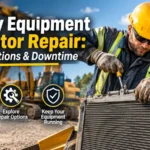
A heavy equipment radiator recore replaces the worn or damaged core while keeping the tanks, frame, brackets, and other parts that are still structurally sound. For excavators, loaders, cranes, mining equipment, and other heavy machinery, it can be a practical alternative to replacing the entire radiator, especially when addressing radiator failure causes.
Re-coring makes the most sense when the core has deteriorated but the rest of the radiator still has useful service life. Full replacement is usually the better choice when damage extends beyond the core, or when rebuilding would no longer give dependable operation.
The right choice comes down to condition, cost, parts availability, downtime, and how the machine is used. For the full picture of repair, re-coring, and replacement, see our heavy equipment radiator repair guide.
The radiator core, part of heavy equipment radiator cleaning, is where heat leaves the coolant. It’s made of tubes that carry coolant and fins that pass the heat into the airflow. Over time, tubes and fins corrode, become restricted, crack, or get damaged.
A re-core replaces that core. Our re-coring process works like this:
Inspect the tanks, frame, and mounts to confirm they’re worth keeping.
Remove the failed core.
Clean and repair the reusable tanks, brackets, and fittings.
Fit a suitable replacement core.
Rebuild the radiator assembly.
Pressure test the finished radiator before it goes back into service.
Re-coring is more than patching a leak. It replaces the main heat-transfer section of the radiator. See our radiator re-coring and performance upgrades service for details.
A re-core is also a chance to match the cooling capacity to how the machine works today.
Original-spec core: restores the radiator to its original cooling performance.
Upgraded core: where the application needs it, we can adjust the core configuration, airflow design, and thermal capacity. This is useful for machines that now run harder, hotter, or longer than they were originally specified for.
Material matters too. Copper-brass radiators are generally the easiest to re-core. Aluminum radiators with plastic tanks offer fewer options, and replacement is sometimes more practical. Our comparison of aluminum vs. copper-brass radiators explains the trade-offs.
Re-coring is most attractive when the core is the problem but the rest of the radiator is still worth saving. We typically recommend a re-core when we see repeated core leaks, serious internal corrosion, blocked tubes, poor cooling performance, or significant fin and tube deterioration.
The tanks are structurally sound
The frame and mounting brackets are reusable
The core shows widespread deterioration
Cleaning can’t clear the internal restriction
Core leaks keep coming back
A replacement radiator is expensive
An exact replacement is hard to source
The machine uses an older or custom radiator design
Re-coring is especially useful for older heavy equipment. A productive excavator or loader may have years of work left even after its original radiator is no longer readily available. Rebuilding the existing assembly avoids a long search for an exact replacement.
The tanks are severely cracked
The mounting structure has failed
Several major components are damaged
The assembly has deteriorated to the point where a rebuild would be unreliable
Base the decision on an inspection, not the radiator’s age alone. If you’re still working out what’s wrong, start with our guide to the signs your radiator needs repair or re-coring.
Not sure if your radiator can be re-cored? Request a free inspection and we’ll tell you which option makes sense.
In upfront cost, a re-core usually falls between a minor repair and a full replacement. There’s no single price for a heavy equipment radiator re-core. Cost depends on factors such as:
Radiator size and design
Core dimensions and configuration
Tank condition
Equipment application
Any fabrication required
Availability of the replacement core
Testing requirements
Performance upgrades
Reusing sound tanks, frames, and mounting hardware is what makes re-coring cost-effective. You replace the part that failed instead of scrapping components that still work.
Purchase price is only part of the calculation, though. A cheaper radiator that takes weeks to arrive can cost more than a rebuild that gets the machine back to work sooner. Idle crews, rental equipment, and delayed jobs all belong in the comparison. We break this down in the real cost of radiator downtime, and in more detail in our repair vs. replacement cost breakdown.
Re-core. Turnaround depends on the radiator’s size, core availability, any fabrication required, and the condition of the reusable parts.
Replacement. Speed depends almost entirely on stock. If the exact radiator is on the shelf, replacement can be faster. For older, specialized, imported, or less common equipment, long OEM lead times can make re-coring the radiator already in hand the quicker route.
Check availability before you assume replacement will get the machine running sooner. If your equipment is down, tell us when you call and we’ll prioritize the job.
Re-coring removes the old heat-transfer core and installs a new one, keeping the usable tanks, frame, brackets, and fittings. The rebuilt radiator is then pressure tested before it returns to service.
It can be. Re-coring saves cost by reusing serviceable parts instead of replacing the entire radiator. The actual saving depends on the radiator, core availability, any other repairs needed, and the cost of a suitable replacement.
There’s no fixed lifespan for every re-cored radiator. Service life depends on the quality of the new core, coolant maintenance, operating conditions, workload, airflow, vibration, and corrosion exposure. A properly selected and installed core restores dependable cooling, and how the machine is used determines how long it lasts.
Often, yes. Older equipment is a good candidate when the tanks, frame, and mounts are still usable but an exact replacement is expensive or hard to find.
Yes. Where the application needs it, an upgraded core with a different configuration or higher thermal capacity can give more cooling capacity than the original unit.
If the tanks, frame, and brackets are sound, a re-core restores cooling performance without paying for parts that still work. If deterioration goes beyond the core, replacement is the better call.
King Radiator HD Inc. provides radiator re-coring, rebuilding, pressure testing, performance upgrades, and heavy equipment radiator repair from our Mississauga facility, serving customers across Canada.
Need heavy equipment radiator repair? Contact King Radiator HD at 888-603-1655 or 905-795-9009.