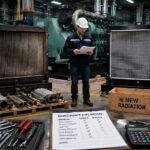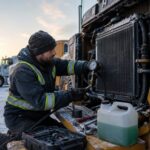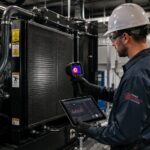

Heavy equipment radiator repair costs 40–60% less than full replacement when damage is localized to a single tank, core, or hose assembly. Replacement becomes the smarter financial decision when the radiator core shows structural failure, corrosion across multiple zones, or repeated breakdowns within 12 months. Downtime not parts is typically the largest cost driver in either scenario.
Heavy equipment engines rarely fail without warning. Fleet managers typically see early signals: a slight rise in the temperature gauge, a faint coolant smell after shutdown, or an operator reporting the machine has been “hunning hotter than usual.” These are not minor inconveniences they are early indicators of radiator stress that, if ignored, escalate into full engine overheats costing $15,000–$80,000 in repairs or replacements.
The critical decision point arrives before the machine breaks down completely in that early, uncertain window where fleet managers must weigh whether heavy equipment radiator repair is viable or whether full radiator replacement is the financially smarter move.
The wrong decision doesn’t just affect repair costs. It creates a ripple effect across the entire operation: delayed job sites, idle operators, missed contract deadlines, and compounding pressure on the remaining fleet. For a single excavator or bulldozer, one week of unplanned downtime can cost a fleet operation $5,000 $12,000 in lost productivity.
So the question isn’t simply: repair or replace? It’s: which option delivers the lowest total cost of ownership over the next 12–24 months?
What this guide covers:
A radiator issue rarely exists in isolation. It affects scheduling, fuel efficiency, engine wear, and crew productivity.
What makes this more complicated is that many fleet managers focus only on visible costs parts and labor while underestimating the hidden ones.
Let’s make it simple.
Heavy equipment radiator repair cost typically includes:
Replacement costs go beyond just the unit:
Now layer in downtime.
According to a report by the U.S. Department of Energy, unplanned downtime in industrial operations can cost up to $260,000 per hour in some sectors.
Even if your operation runs far below that figure, the pattern holds:
Downtime quickly outweighs the cost of the part itself.
Downtime isn’t just lost time. It’s compounded loss.
A single overheated machine can trigger:
That’s why the heavy equipment downtime cost conversation matters just as much as the repair itself.
A radiator failure in peak season? That’s not a repair bill. That’s operational disruption.
This leads to a more practical question:
Here’s the simplest way to look at it:
Radiator repair focuses on restoring function.
Replacement focuses on restoring reliability.
Both options have value; the right decision depends on the radiator’s condition, not just its age.
If the core structure is intact and damage is isolated, repair is usually viable.
If corrosion, repeated failures, or internal blockage exist, replacement may be the safer long-term move.
Not every overheating issue means starting from scratch.
In fact, many radiators fail in ways that are surprisingly repairable.
That said, repair isn’t always the best answer; sometimes, trying to stretch a failing unit creates more problems than it solves.
There’s a point where repairing becomes a short-term patch rather than a solution.
At that stage, replacement isn’t just about fixing the issue.
It’s about restoring confidence in the equipment.
Still, replacement carries its own risks, especially around cost and lead time.
This is where many fleet managers hesitate.
Because on paper, replacement seems cleaner. But in practice, it’s not always the most efficient.
Here’s a simplified comparison to help you evaluate your options:
| Option | Upfront Cost | Downtime Impact | Longevity | Risk Level |
| Minor Repair | Low | Minimal | Short to medium | Moderate |
| Full Recore | Medium | Moderate | Long | Low |
| OEM Replacement | High | High (depending on availability) | Long | Low |
| Aftermarket Replacement | Medium | Variable | Variable | Moderate |
Recore sits in a unique middle ground between repair and full replacement.
Instead of replacing the entire radiator, the internal core is rebuilt while retaining the outer structure. This often results in:
It’s not always discussed upfront, but it can be one of the most balanced options available.
Routine servicing often gets overlooked until something fails. But it quietly shapes the lifespan of your cooling systems.
These aren’t just maintenance tasks; they act as early warning systems.
A clogged radiator, for example, might reduce efficiency long before it triggers overheating. Catching that early can mean the difference between a simple clean and a full rebuild.
Before committing to repair or replacement, a structured evaluation changes everything.
This kind of process avoids guesswork. It replaces reactive decisions with informed ones.
Several common patterns tend to repeat across fleet operations:
Sometimes replacement feels safer but it may not be necessary if the radiator is structurally sound.
Small issues compound. What starts as a leak can become internal damage.
Skipping diagnostics often leads to assumptions rather than informed decisions.
Instead of guessing, use this simple lens:
It’s not about choosing the cheapest option; it’s about choosing the most reliable one.
On the surface, radiator decisions look straightforward.
Fix it or replace it.
But in real-world operations, it’s rarely that simple.
The smarter choice depends on condition, timing, and how much disruption your operation can tolerate. Heavy equipment radiator repair often delivers strong value but only when applied at the right moment.
That’s where experienced assessment matters.
For fleet operators looking to reduce downtime and make informed decisions, working with a specialist like King Radiator HD Inc can help you make faster, data-driven decisions that reduce downtime and protect your bottom line with long-term operational efficiency especially when downtime isn’t an option.