Most generator failures don’t come out of nowhere. They build up quietly a slightly clogged fin here, a bit of corrosion there until one day the system just can’t keep up anymore. If you’ve ever dealt with an unexpected shutdown during a critical operation, you know exactly how costly that moment is. And most of the time, it was preventable.
This guide walks through what actually works when it comes to cooling maintenance for marine heat exchangers and stationary generator radiators not just the theory, but the practical steps that keep systems running when they’re needed most.
Saltwater doesn’t just corrode metal it actively attacks it. Any operator running a marine generator knows this, but it’s easy to underestimate how fast the damage accumulates.
A standard marine cooling setup pulls raw water through heat exchangers to manage engine temperature. That sounds simple enough. The problem is what that water carries with it salt deposits, dissolved minerals, and in many cases, stray electrical currents that accelerate electro chemical corrosion.
This is why marine heat exchanger repair and service ends up being an ongoing commitment rather than a one-time fix. The system doesn’t get a break from the environment. Neither can the maintenance schedule.
What Happens When You Miss a Cycle
The early signs are subtle. A slight rise in operating temperature. A marginal drop in heat transfer efficiency. Easy to dismiss, especially if the generator is still running within normal parameters.
But underneath the surface, salt deposits are narrowing internal passages, micro-corrosion is weakening metal walls, and electrochemical pitting is spreading. None of it pauses because you skipped an inspection.
A complete cooling maintenance approach for marine systems typically includes:
Miss one cycle, and the damage doesn’t just pause it compounds. The next inspection will have more to address, and the risk of failure in the meantime is higher.
Here’s something that surprises a lot of facility managers: emergency generators that sit unused for months are often in worse shape when they finally run than units that operate regularly.
Inactivity is hard on cooling systems. Coolant degrades over time even without use. Internal passages develop sediment. Rubber seals harden and lose their flexibility. And when the generator finally kicks on during a real outage at full load, under pressure every one of those weaknesses shows up at once.
This is exactly where stationary generator radiator repair becomes critical, and where a lot of operations fall short. They assume that because the generator hasn’t been running, it doesn’t need attention.
What Actually Happens at Startup after Long Idle Periods
When a standby generator starts under emergency load:
Consistent cooling maintenance for standby systems means pressure-testing radiators before emergencies, not during them. It means keeping coolant chemically stable through regular testing and replacement. It means ensuring airflow pathways stay clear even when the generator isn’t in active use.
Because when the power goes out, there’s no time to discover that the cooling system wasn’t ready.
The debate between copper/brass and aluminum radiator cores gets oversimplified a lot. Aluminum is lighter and often cheaper, so it gets positioned as the modern upgrade. In some applications, that’s true. In others, it’s a costly mistake.
When evaluating heavy duty radiator core materials for harsh environments, the differences that matter most aren’t about weight or cost they’re about longevity and repair ability.
| Factor | Copper/Brass | Aluminum |
| Corrosion resistance | Excellent in saltwater/marine | Adequate in controlled environments |
| Heat dissipation | Good, especially under sustained load | Strong under ideal conditions |
| Repair ability | Can often be re-cored or repaired | Usually requires full replacement when damaged |
| Weight | Heavier | Lighter |
| Best environment | Marine, high-vibration, harsh conditions | Controlled industrial or light-duty use |
The repair ability point matters more than most people realize. When a copper/brass core is damaged, it can often be rebuilt rather than replaced entirely. That means less downtime, lower cost, and a system that’s back in service faster. With aluminum, once the damage is done, you’re usually looking at a full replacement.
In salt-heavy environments or systems that absorb a lot of vibration, copper/brass tends to outlast aluminum despite the added weight. Good cooling maintenance starts with choosing the right material for the actual conditions not just the lightest or most available option.
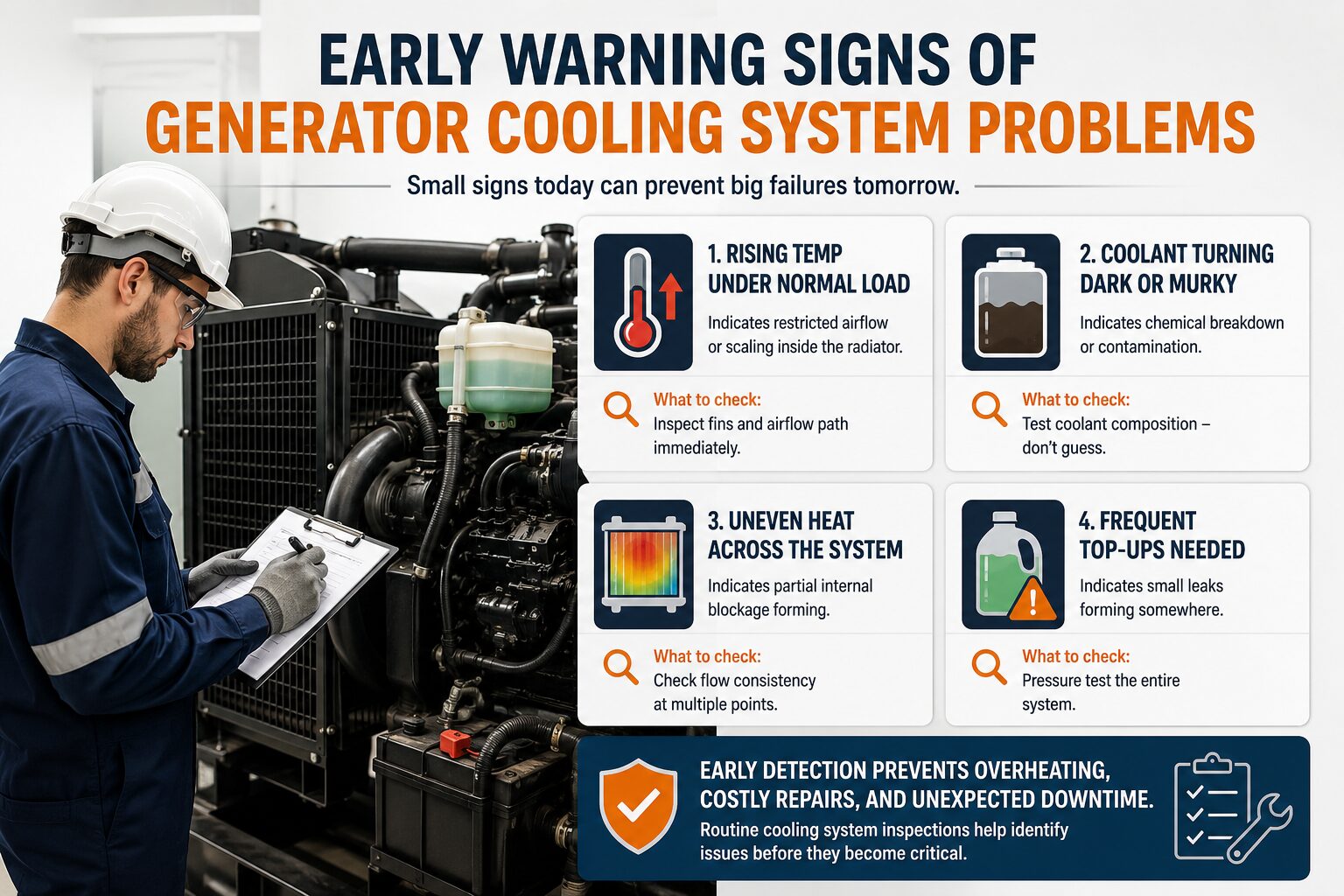
Cooling systems almost never fail without warning. The issue is that the warnings are easy to rationalize away especially when the generator is still technically running. Here’s what to watch for:
| Early Warning Sign | What It May Indicate | Simple Check | Common Oversight |
| Rising temp under normal load | Restricted airflow or scaling inside the radiator | Inspect fins and airflow path immediately | Operators brush off minor temp drift — big mistake |
| Coolant turning dark or murky | Chemical breakdown or contamination | Test coolant composition — don’t guess | Assuming coolant lasts forever without testing |
| Uneven heat across the system | Partial internal blockage forming | Check flow consistency at multiple points | Skipping internal inspection during routine service |
| Frequent top-ups needed | Small leaks quietly forming somewhere | Pressure test the entire system | Treating coolant loss as normal evaporation |
These signs rarely appear all at once. Typically it starts with one maybe a slightly higher temperature reading under normal load. Then a second appears. Then the coolant needs topping up more often. By the time all four are present, the system is already well into its failure cycle.
Structured cooling maintenance interrupts that cycle early, before visible symptoms turn into operational failures.
The most effective inspections aren’t complicated. They’re consistent. Here’s what a solid inspection covers:
This kind of routine shifts maintenance from reactive to predictive. Small issues get caught before they become system failures.
A slight restriction in airflow raises internal temperatures. Higher temperatures accelerate coolant degradation. Degraded coolant reduces heat transfer efficiency. That reduced efficiency raises temperatures further. It’s a cycle, and it only moves in one direction toward failure.
Regular inspection breaks the cycle before it builds momentum.
Older marine engines present a specific challenge that newer systems don’t: the parts simply aren’t available anymore. Standard replacements don’t fit the original specifications, and forcing modern components into aging systems often creates more problems than it solves.
This is where custom marine radiator fabrication becomes necessary not as a workaround, but as the right solution.
Custom fabrication allows technicians to match original specifications precisely, improve internal flow design where the original had weaknesses, and reinforce structural areas that have degraded over time. The result is a system that functions correctly for that specific engine, not a generic part that almost fits.
Re-Coring: The Option Most Operators Overlook
Re-coring is often a better choice than full replacement, but it’s consistently underutilized. Instead of replacing the entire radiator, the core is rebuilt while preserving the outer structure. This approach is typically faster, more cost-effective, and in many cases produces a more reliable result than installing a brand-new unit.
For marine fleets where operational consistency matters where you need every vessel running the same reliable setup re-coring fits naturally into a long-term cooling maintenance strategy.
The most common mistake is treating radiators as passive components something that works in the background until it suddenly doesn’t. That assumption creates the exact blind spots that lead to failures.
| DO | DON’T |
| Track temperature patterns over time, not just peak readings | Assume coolant alone keeps the whole system healthy |
| Schedule inspections even during low usage or standby periods | Ignore small temperature fluctuations as ‘probably fine’ |
| Match radiator material to your actual operating environment | Delay service because the generator hasn’t overheated yet |
| Replace zinc anodes before they fully degrade | Skip internal inspection just because the outside looks clean |
| Pressure test your system at least once a year | Treat frequent top-ups as normal instead of investigating leaks |
Cooling systems don’t fail suddenly. They degrade over time, quietly, until a threshold is crossed. The operators who avoid expensive failures are the ones who catch that degradation early not the ones who wait for visible symptoms.
Heavy-duty cooling systems marine heat exchangers, industrial generator radiators, custom fabrications for aging engines require more than standard repair work. They require experience with how these systems behave under real operating conditions, across different environments, over long service cycles.
King Radiator HD Inc has spent decades working across industrial and marine sectors. Their approach leans toward repair, restoration, and custom solutions rather than default replacement which matters when downtime is expensive and finding the right part for an older system isn’t straightforward.
Services include industrial radiator rebuild services, marine heat exchanger repair, re-coring for both copper/brass and aluminum units, custom fabrication for obsolete engines, and full system inspection and maintenance programs.
Restoring a system properly with the right materials and the right approach consistently extends its life beyond what a quick replacement would achieve.
A cooling system doing its job doesn’t draw attention. The engine runs at the right temperature, the generator starts when it’s supposed to, the marine vessel completes its route without incident. Nobody notices. That’s exactly how it should be.
But when cooling maintenance gets deprioritized when inspections get skipped, coolant goes untested, fins stay blocked that quiet reliability disappears. And when it finally fails, it never fails at a convenient time.
Consistent maintenance doesn’t just extend equipment life. It removes uncertainty. In environments where failure carries real consequences emergency power, marine operations, industrial facilities that reliability is worth more than most operators realize until the moment they need it.
A reliable system maintains stable temperature under varying load conditions, resists corrosion appropriate to its environment, and allows efficient heat transfer without flow restrictions. Material choice, coolant condition, and airflow management all contribute equally.
Routine inspection, regular coolant testing (not just visual checks), airflow cleaning, and annual pressure testing prevent the majority of avoidable failures. The key is consistency not frequency.
Regular flushing to remove salt deposits, consistent monitoring for stray current corrosion, and timely zinc anode replacement are the core practices. Internal tube cleaning before blockage becomes severe is equally important and often overlooked.
If overheating persists after basic maintenance, coolant degrades faster than expected, internal corrosion is suspected, or you’re dealing with an older engine where standard parts are no longer available professional inspection and service becomes necessary.
King Radiator HD Inc handles repair, re-coring, custom fabrication, and full cooling system servicing for heavy-duty marine and industrial equipment. They specialize in restoration over replacement, which typically results in better long-term reliability at lower cost.