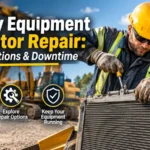
A failing heavy equipment radiator usually gives warning signs before it leaves a machine down: rising temperatures, coolant loss, visible leaks, damaged fins, or overheating under load, indicating a need for radiator services.
These heavy equipment radiator symptoms shouldn’t be ignored. A localized problem may need only a straightforward repair. Repeated leaks, internal corrosion, or a worn core usually point to re-coring.
Knowing the difference early helps fleet managers avoid unnecessary replacements and reduce the risk of unexpected downtime. For the bigger picture, including repair, re-coring, replacement, and what a professional repair involves, see our heavy equipment radiator repair guide.
Radiator failure doesn’t always start with a major leak or a full overheat. More often, cooling performance declines gradually. Watch for these signs.
A gradual rise in operating temperature is often the first sign that the cooling system needs attention. Common causes include:
clogged fins
low or degraded coolant
internal scale
a deteriorating core
a weak or faulty fan
The pattern matters most. Watch for temperatures that climb during digging, pushing, lifting, or hauling but stay near normal at idle. That usually means the radiator can’t shed enough heat at peak load. We walk through this diagnosis step by step in our guide to diagnosing excavator overheating, and the same principles apply to bulldozer overheating.
Coolant loss is worth investigating even if there’s no puddle under the machine. Some small leaks only show up once the system reaches operating temperature and is under pressure.
Look for damp spots, staining, and dried coolant residue on the core, tanks, and seams. Topping up coolant hides the symptom; it doesn’t fix the leak.
Safety note: Never open the radiator cap on a hot system. Hot coolant under pressure can cause serious burns. Let the machine cool first, or have the system pressure tested by a professional.
Check the radiator for bent fins, damaged tubes, corrosion, staining, and physical damage. Vibration, dust, and dirt damage fins and restrict airflow, and over time they corrode tubes. Radiator cores also deteriorate with age.
Internal corrosion is harder to spot. Old or contaminated coolant can leave deposits inside the tubes that stop coolant from circulating efficiently. We cover the root causes in more detail in common causes of radiator failure on job sites.
Mud, dust, chaff, bent fins, and oil residue can all block airflow through the core. A radiator can be full and leak-free and still fail to cool the engine if air can’t get through.
Cleaning clears some external restrictions; our radiator maintenance checklist covers how to do it safely. If the machine keeps overheating even after regular cleaning, the likely cause is internal restriction or core deterioration.
Coolant should look clean. Rusty, cloudy, or sludgy coolant points to internal corrosion or contamination. Oil in the coolant can point to a problem beyond the radiator, such as an oil cooler failure, and needs prompt attention.
Constant vibration stresses radiator tanks, seams, and mounting points. Look for cracks, weeping seams, and loose or broken mounts. Left alone, a small crack can grow into a major leak.
Many machines stack the radiator with a hydraulic oil cooler or a charge air cooler. If the cooler in front is packed with debris, the radiator gets less airflow and the machine runs hot, even though the radiator itself may be fine. Always inspect and clean the whole cooling package.
Seeing any of these signs? Request a free radiator inspection before a small problem takes a machine off the job.
Repair and re-coring solve different problems.
A repair fixes a localized issue and keeps the existing core.
A re-core replaces the failed core and repairs any damaged fittings, while reusing the tanks, frame, and mounts where they’re still sound.
|
Option |
Usually Appropriate When |
|---|---|
|
Repair |
The leak or damage is localized and the existing core is still usable |
|
Re-core |
The core is badly restricted, repeatedly leaking, corroded, or generally worn |
|
Replacement |
The tanks, frame, or other major structural components are beyond practical repair |
A single localized leak can usually be repaired. Leaks that keep appearing in different spots usually mean the core itself is deteriorating.
Re-coring is the better option when cleaning can’t clear internal blockage or corrosion. It’s especially useful for older or specialized machines where a complete replacement radiator is expensive or hard to source. After re-coring, the complete unit is pressure tested before it goes back into service.
Learn more about our radiator re-coring service, read when re-coring beats a full replacement, or compare options in our repair vs. replacement cost breakdown.
Coolant level and condition
Visible leaks, staining, or dried residue
Bent or clogged fins
Loose mounts and damaged hoses
Debris on the oil and charge air coolers
Pressure testing to find hidden leaks
Assessing internal corrosion and restriction
Deciding whether the core can be repaired or needs re-coring
Book an inspection if:
overheating persists
coolant keeps dropping
leaks are hard to trace
the radiator shows heavy corrosion or physical damage
An overheating machine doesn’t always mean a failed radiator. The thermostat, water pump, fan system, coolant condition, hoses, or airflow could also be the cause.
A professional inspection, including a pressure test, confirms whether the radiator needs cleaning, a spot repair, re-coring, a rebuild, or replacement. We repair, re-core, and rebuild radiators for excavators, cranes, loaders, compressors, stationary power units, and other heavy equipment. See our heavy equipment radiator repair services for details.
A re-core may be the right choice in these cases:
the core has repeated leaks
internal corrosion is extensive
the tubes are seriously restricted or damaged
cooling performance stays poor after cleaning and localized repairs
If the tanks and frame are still structurally sound, replacing the core can restore the radiator without replacing the complete assembly.
Common causes include blocked fins, restricted airflow, low or degraded coolant, internal scale, a deteriorating core, thermostat problems, water pump issues, and fan inefficiency. More than one problem can be present at the same time.
Not for long. Running a machine that is overheating or losing coolant puts extra stress on the engine and other cooling-system components. If the temperature reaches the warning zone, stop and let the machine cool. Book an inspection before putting it back under heavy load.
Sometimes. If the problem is external debris blocking airflow, a thorough cleaning can restore performance. If the machine still overheats after cleaning, the cause is likely internal restriction, core deterioration, or another cooling-system component.
Localized damage may only need a repair. Widespread core deterioration may make re-coring the better choice. Either way, the right decision starts with an inspection rather than an assumption that a damaged radiator must be replaced.
King Radiator HD Inc. provides radiator repair, rebuilding, re-coring, pressure testing, and cooling-system services for heavy equipment and industrial applications across Canada, from our in-house facility in Mississauga, Ontario.
Need heavy equipment radiator repair? Contact King Radiator HD at 888-603-1655 or 905-795-9009.